
Maybe you are new to messaging. Or maybe you have been around the block and have experience using tools like Azure Service Bus. Either way, the real question is: What do you know about NServiceBus?
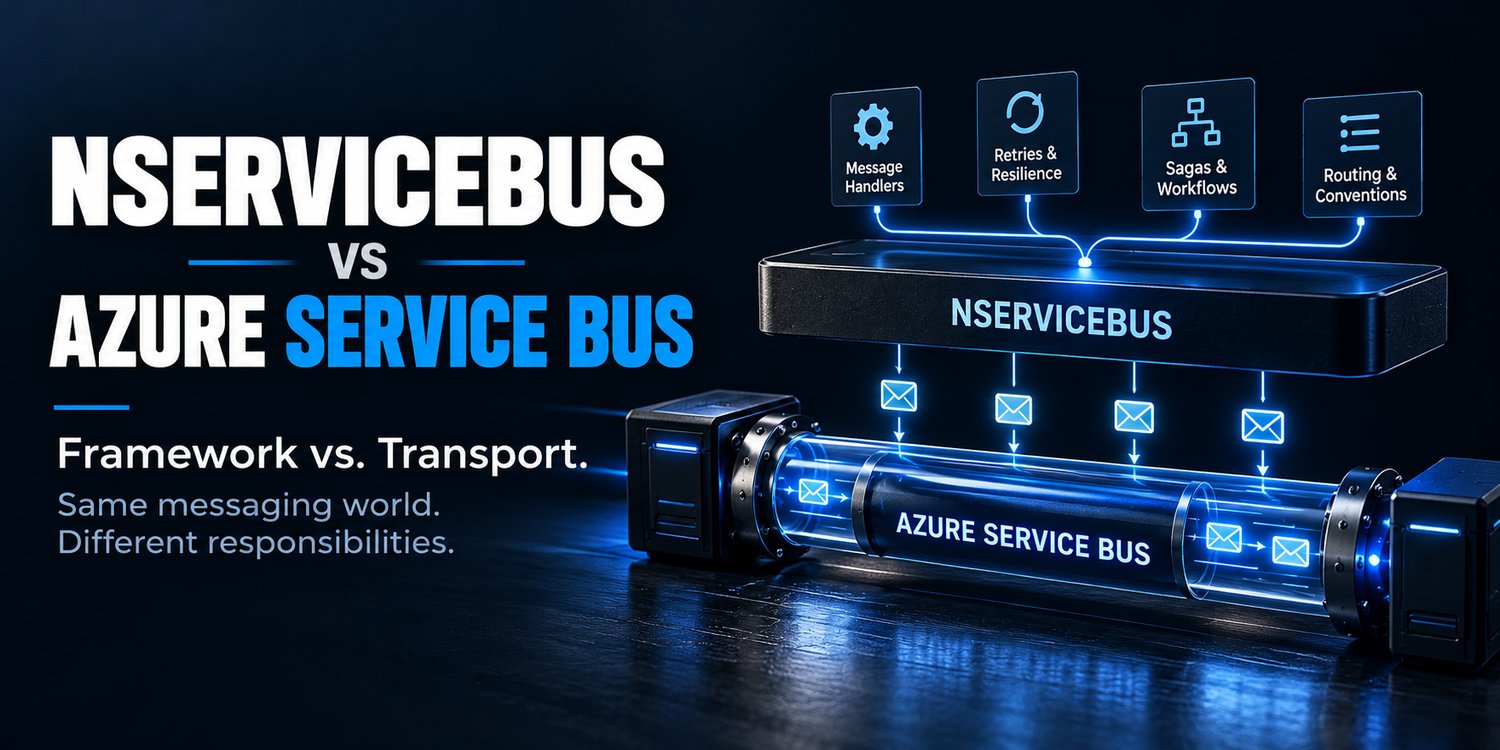
How does NServiceBus (NSB) compare to Azure Service Bus (ASB)? The short answer is that they are related, but they are operationally different. Azure Service Bus is the transport that moves messages between queues and topics. NServiceBus is an application layer on top of the transport that helps you design, execute, and operate reliable message-driven distributed systems.
That distinction matters because the real comparison is not NServiceBus versus Azure Service Bus. It is the Azure Service Bus SDK versus NServiceBus, and even that comparison only makes sense once you understand the layer each one is responsible for.
At first glance, the overlap can be confusing. Both let you send and receive messages. Both can be part of a system that retries failed work and handles messages that cannot be processed. So, what is the difference between using the Azure.Messaging.ServiceBus NuGet package directly and using NServiceBus?
The Azure.Messaging.ServiceBus package is a transport client. It gives you a low-level API for sending and receiving messages through Azure Service Bus, but the application patterns around those messages are still yours to design and maintain.
NServiceBus is different. It is a message-driven application framework: a platform for building distributed systems on top of a transport. It lets developers focus on business logic while providing the infrastructure patterns needed for reliable messaging.
Same transport, different responsibilities
Instead of thinking about this as a product-versus-product comparison, it helps to compare the responsibilities each tool takes on.
What it is
Azure Service Bus SDK: A transport client that lets you send and receive messages through Azure Service Bus.
NServiceBus: An application framework for building distributed, message-driven systems on top of a transport.
Level of abstraction
Azure Service Bus SDK: Low-level. You work directly with messages, queues, topics, subscriptions, and broker behavior.
NServiceBus: Higher-level. You work with message handlers, sagas, recoverability, the outbox, and business workflows.
Responsibility
Azure Service Bus SDK: Moves messages between endpoints.
NServiceBus: Helps your application process messages reliably as part of a business workflow.
Retries and recoverability
Azure Service Bus SDK: Gives you transport-level behavior, but application-level retry and recovery policies are yours to design.
NServiceBus: Provides recoverability policies for message-processing failures, including retries and error handling patterns.
Long-running workflows
Azure Service Bus SDK: Does not provide a workflow model by itself.
NServiceBus: Provides sagas for coordinating long-running business processes across multiple messages and endpoints.
Idempotency
Azure Service Bus SDK: You design and implement your own idempotency approach.
NServiceBus: Provides the outbox pattern to help avoid duplicate side effects when messages are retried.
Message versioning
Azure Service Bus SDK: You define your own conventions for message contracts and compatibility.
NServiceBus: Provides conventions that help teams manage message contracts consistently over time.
Error handling
Azure Service Bus SDK: Failed messages may end up in dead-letter queues, but the operational workflow is up to you.
NServiceBus: Uses error queues, recoverability policies, and operational tooling patterns to make failures easier to diagnose and retry.
Message Serialization
Azure Service Bus SDK: Serialization is manual and application-specific.
NServiceBus: Serialization is convention-based and pluggable.
Transactions
Azure Service Bus SDK: Transaction support depends on how you use the broker and your application code.
NServiceBus: Provides higher-level patterns for coordinating message processing, persistence, and outgoing messages.
Your team doesn’t need more processes. It needs more confidence.
The Six Disciplines of Confidence Engineering lays out a practical path to safer, faster, more predictable software delivery—build better products and deliver value faster without adding more ceremonies, gates, or meetings.
Comments ()