
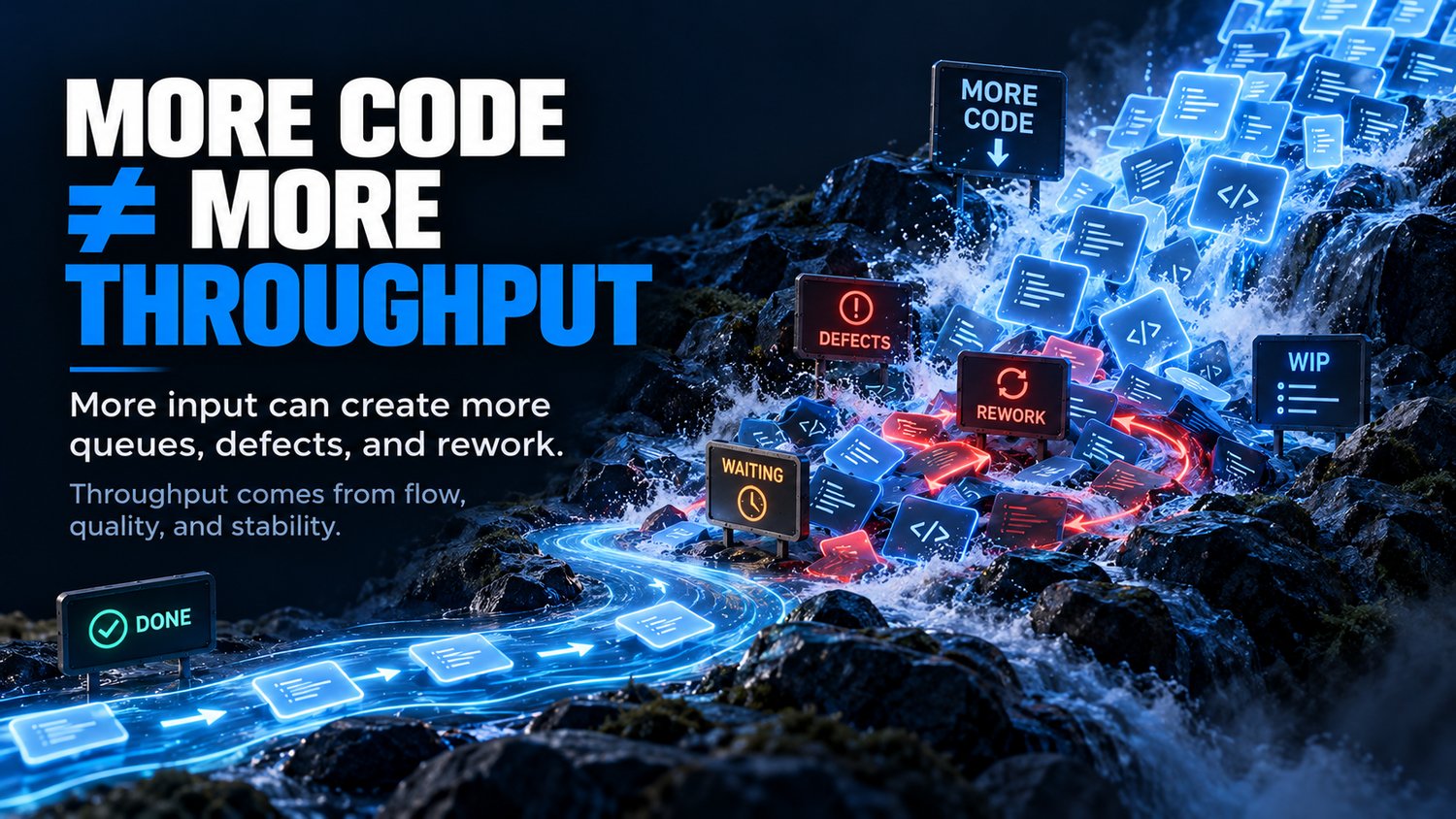
One of the easiest mistakes to make with AI is to confuse more output with more delivery.
A developer completes a change faster. More pull requests are opened. More code is generated. More work reaches “dev complete.” From a distance, that looks like productivity.
But software delivery does not end when code is written. A change may still wait for review, testing, integration, deployment, approval, release, and production validation. If any of those stages are constrained, increasing coding speed does not necessarily make the whole system faster.
It may simply move the bottleneck.
The Bottleneck Is Often Not Coding
Most engineering organizations do not suffer from a shortage of code. They suffer from too much waiting, too much rework, too many handoffs, too many defects, and too much uncertainty between “code written” and “value delivered.”
A developer may finish a change in a few hours, but the work can sit in review for a day, wait in QA for several more, then sit again for a release window. If the change fails downstream, it returns for rework and consumes even more capacity.
In that environment, making coding 30 percent faster does not make delivery 30 percent faster. The bottleneck is somewhere else.
This is why throughput cannot be improved simply by increasing local output. Throughput is the result of the entire delivery system. It is what remains after defects, rework, waiting, queues, and instability stop consuming capacity. (The Six Disciplines of Confidence Engineering)
Faster Coding Can Create More Inventory
Imagine a team that adopts AI coding tools and starts completing development work significantly faster. At first, the change looks positive. More stories reach development complete, more pull requests are created, and more changes are ready for testing.
Then the downstream system starts to strain.
Code review queues grow because reviewers cannot keep up. QA becomes overloaded. More work waits for shared environments. Larger batches accumulate before deployment. Defects increase because the system is processing more change than its quality mechanisms can absorb.
The team is producing more work, but it is not finishing more work. That is not increased throughput. It is increased inventory.
In software delivery, more inventory means more work in progress, more context switching, more coordination, and more opportunity for defects and rework. AI can accelerate all of that if it is introduced into a constrained system without understanding where the real constraint is.
Measure the System, Not the Activity
The right question is not whether developers are producing more. The better question is whether the delivery system is producing more finished value.
That means looking at outcomes such as cycle time, throughput, rework, defect rates, deployment frequency, rollback capability, and predictability. If coding output increases while waiting, rework, or defects also increase, then the system did not improve. The bottleneck simply moved.
This distinction matters because AI can create the appearance of productivity very quickly. Generated code and completed development work are highly visible. Queues, hidden rework, and downstream congestion are less visible, but they are where delivery performance is often won or lost.
Optimize the Flow, Not Just the Developer
AI is most valuable when it removes friction from the actual system constraint.
If code review is the bottleneck, use AI to help reviewers understand changes faster. If test creation is the constraint, use it to help generate meaningful tests. If pipeline troubleshooting is slow, use AI to summarize failures and surface likely causes. If observability is weak, use it to help interpret telemetry. If architecture is constraining change, use it to identify coupling and suggest seams for refactoring.
The principle is simple: do not optimize the easiest activity to accelerate. Optimize the actual constraint.
The real test of AI productivity is not whether more code was generated. It is whether more value reached production with the same or lower level of risk.
More code is not more throughput. Throughput is a property of the entire delivery system.
Your team doesn’t need more processes. It needs more confidence.
The Six Disciplines of Confidence Engineering lays out a practical path to safer, faster, more predictable software delivery—build better products and deliver value faster without adding more ceremonies, gates, or meetings.